
No, We Don’t Need Another AI Debate Tool

In the age of low-quality vibecoded software created with Claude Code (or some other adjacent software) for the sole purpose of filling one more slot on a college application, the last thing debate needs is more AI tools. The problem with these tools, though, lies far deeper than their questionable quality and raison d’etre; they simply detract from the debate experience. To analyze this further, let’s ask ourselves what we actually get out of debate, and compare that with what most AI tools add to that experience.
- Education
The most obvious answer seems to be education. Through the process of debating, we sharpen our research skills, learn to think critically about complex subjects, and analyze evidence to find contradictions and inconsistencies. Simply put, most AI debate tools are precisely designed to circumvent that process. Since research is time-intensive, requires critical thinking, and may initially seem fruitless, many AI tools aim to allow debaters to bypass that process entirely via generating cards, blocks, argument ideas, etc. The problem with that is it leaves only the actual debating to the debaters, rather than all the work that goes on behind the scenes leading up to the debating itself. Now, why does that matter? The answer, I would argue, is quite similar to a common argument made in framework debates; we won’t change our minds or learn from rounds themselves, but the iterative process of research and testing that prepares us for those rounds does genuinely make a difference. That means that excluding the research process from the ‘debate curriculum’ of sorts with an AI tool circumvents the majority of education that we gain from the activity as a whole.
Advocates of AI debate tools may argue that researching with AI is far more exportable to real-world research, since many labs are beginning to increase usage of AI in actual academic papers. However, this argument is flawed. While AI can be used in research with great success, most research concludes that building up foundational skills is a necessary prerequisite, and using AI without guardrails can incentivize failure to “actually build those fundamental skills to be able to use these tools effectively in the future.” In that sense, it is true that AI can improve learning and research outcomes. The nuance, though, is that this is only after guardrails have been implemented, and foundational skills have previously been developed absent AI assistance.
- Competitive Success
Another common justification for AI debate tools is competitive success, with sites such as Debatify claiming that their services will enable debaters to “debate better,” a bold claim that might not exactly be true. To find out, we asked 10 of the top-ranked Public-Forum debaters two questions:
- Do you use AI?
- If so, do you find it helpful?
So, can AI make you “debate better”?
Well, maybe.
Out of the 10 debaters we interviewed, four used AI, and three found it genuinely helpful. The other AI user claimed that it was largely unhelpful, and primarily used it to answer hyper-specific questions rather than general research. So, is AI the secret to reaching high levels of success on the national circuit? The answer: probably not. Each of the AI users we polled reported that while AI was useful in some tasks such as drafting extensions, shortening rhetoric for lay cases, and finding specific studies, it failed in a multitude of other critical tasks. Therefore, it seems that (assuming our data is somewhat representative of what most good debaters do) while AI can help in some specific situations, it isn’t going to be some magic solution that will take you from the depths of bidlessness to TOC finals anytime soon. While there are plenty of other justifications for using AI tools in debate, the rest of this article primarily concerns the quality of existing AI tools and an overall review of the current state of AI in debate.
- Current Tools
Therefore, AI tools should not be discounted as a whole, as some tools in some circumstances have valid usage.
Example 1.
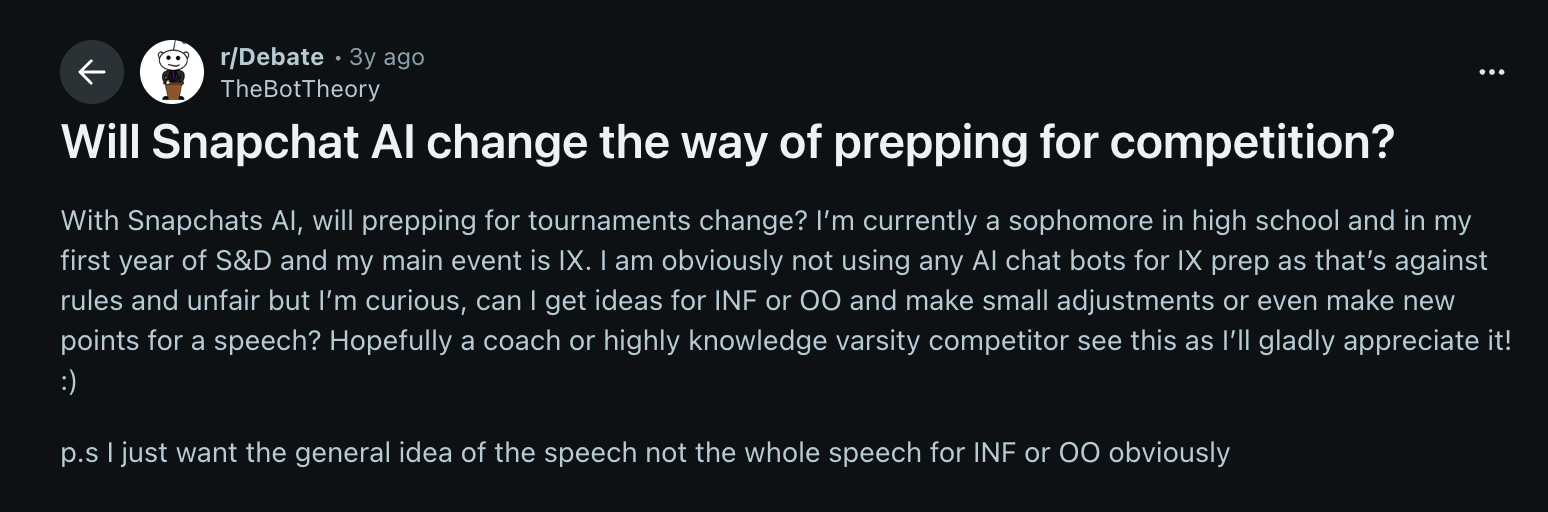
TheBotTheory, circa 2023.
Yeah… maybe this one shouldn’t be taken into consideration.
Example 2.
Arguflow.ai is an AI app that utilizes metadata scraped from opencaselist in order to be used as a search engine, similar to Gemini. The idea seems promising because it would address one of debaters’ biggest pet peeves: the vastness and outdatedness of OpenCaselist. Despite the promised features, clicking on the URL arguflow.ai leads to a dead website, meaning that this project was most likely abandoned a long time ago. Redditor skeptrune even noted that “It costs ~$200/mo to host” , and further investigation reveals that the website was shut down, and replaced with an entirely different app called trieve.ai, where clicking on the link…unfortunately reveals another dead website.
Example 3.
Debatify is often seen as the holy grail of AI Apps inside of the debate community. Although this is a slight exaggeration, it’s not too far off the mark to say that Debatify was able to successfully pull off making an actually useful app. For starters, the website UI is simplistic, and easy to navigate, being a far cry from the bright colors used by obviously vibecoded Claude or Lovable websites. Thus, Debatify’s main appeal comes from the variety of useful add-ons inside of the app. Most of these, however, are behind a $9.99/month paywall, with the only free option being access to the Rhetorify add-on, which is used to turn carded evidence into normal words. Although this is cool, and probably the most useful add-on, what’s more important are the two AI add-ons that can be accessed with premium.
The main one reviewed today is the “Search with AI” add-on, that generates cards by using artificial intelligence. Using the prompt: “Russia war causes extinction”, the website generated numerous cards in only a couple seconds.
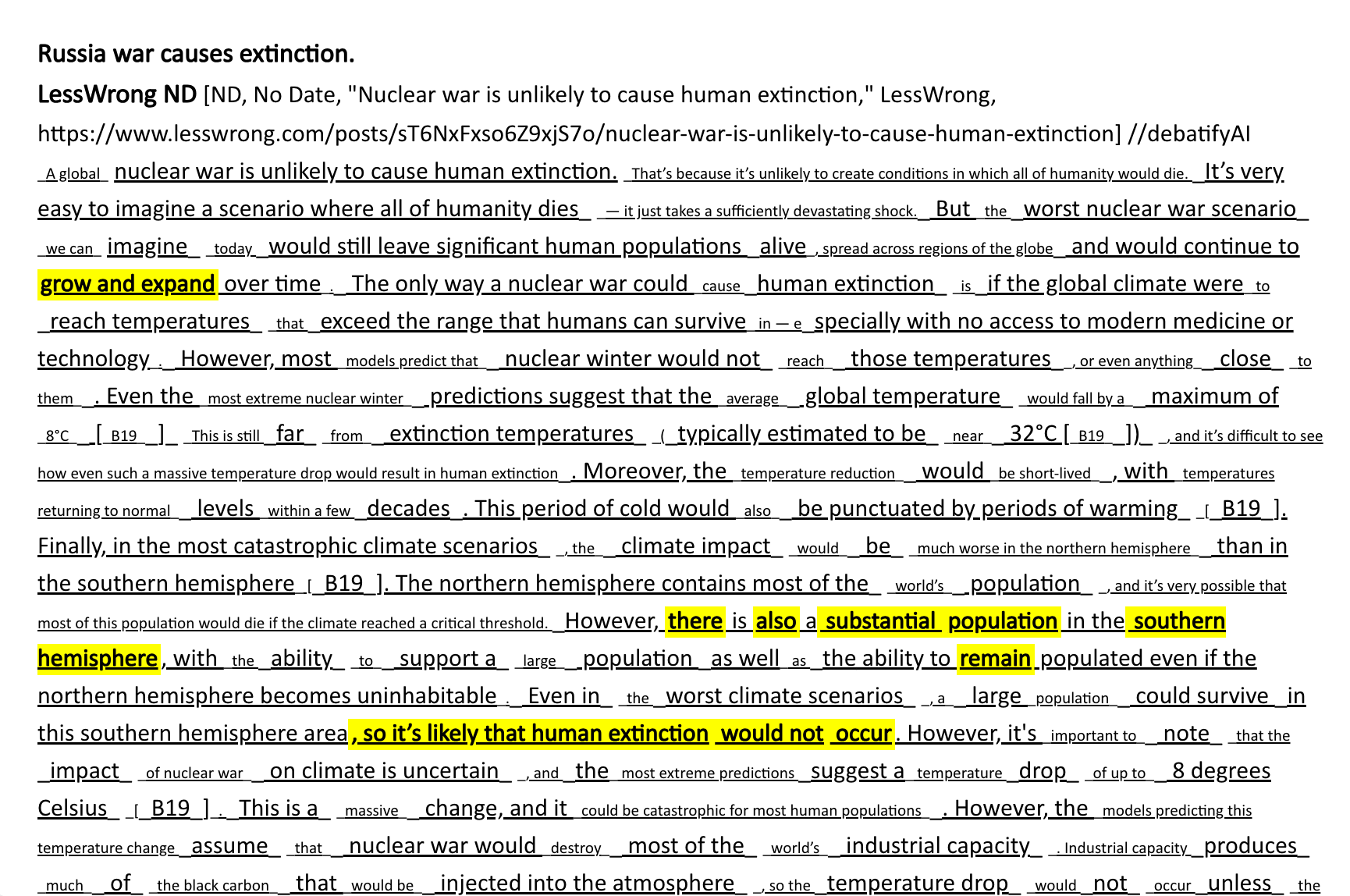
Debatify, 2026.
Uhhh…what is going on here? Everything is underlined, some things are underlined but shrunk, the highlighted words grammatically don’t make sense, and worst, it literally says that “human extinction would not occur.” This is being nitpicky, as some of the other results came out slightly better.
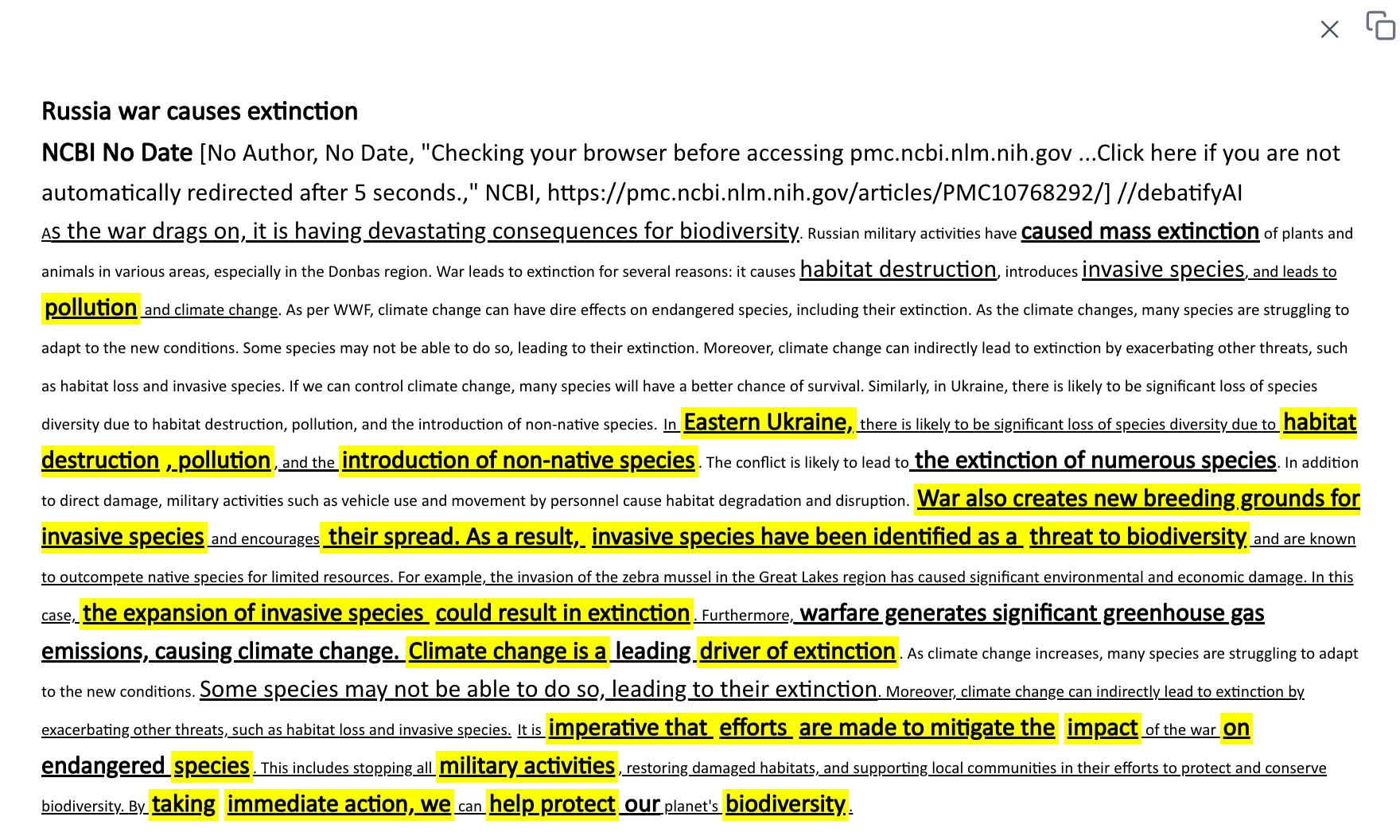
Debatify, 2026.
This card is promising, with the only main problem being the citation. The rest of the card makes sense (almost) grammatically, and directly issued what was originally prompted, being that Russia war causes extinction.
Overall, Debatify is one of the more promising apps in the long lineup of awfully made AI “Passion Projects” created by people in the debate space. People reading this should not look at this as an approval for AI, but instead as a cautious warning that apps, AI or not, require thorough work put into them, and cannot be simply made with a one-paragraph prompt. This, unfortunately, reveals one of the shortcomings of Debatify, being that almost all of their features are stuck in beta, which represents a large problem every single AI project faces, being their lack of development. Websites made by high school or college students with little to no freetime, usually being solo projects, means that these sites are bound to be slow in development, where people inevitably would stop using them, or these websites would end up being abandoned entirely.
This brings up another problem, being the longevity of the projects themselves. Chatbots such as Claude have been rapidly increasing their prices as a result of their sudden popularity, causing tokens to be ridiculously expensive. Combined with a young high school student who is disinterested in maintaining a functioning project, this causes almost all of these websites to be discontinued within a few months, usually citing budget issues, lack of support, or even an immediate closure after graduation. This unfortunately leads to many unique ideas to come out half-baked, and failing to meet expectations on core features.
- The Verdict
While AI can have a genuine place in educational spaces, we would argue that debate is not one of those spaces—at least not yet. Currently, the debate space lacks sufficient guardrails to prevent AI tools from becoming a crutch rather than an assistant, potentially leading many students to avoid learning fundamental debate principles rather than taking the time to truly take all that they can from this activity. Although in some instances AI tools can be helpful assistants for research and preparation, these tools are often inconsistent in output, lacking the longevity required to prove truly helpful. More importantly, though, is that even if AI tools were some secret code to winning every tournament, that still wouldn’t justify their use. Ruining the educative value of debate for cheap wins is exactly the opposite of what our already-hypercompetitive activity needs.